
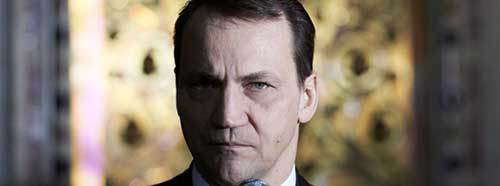
 In a Spiegel interview on March 11, Polish Foreign Minister Radoslaw Sikorski, 51, argues Moscow is more vulnerable than many think, and that the EU should take a firmer stand against Russia in the Ukraine conflict. An excerpt:
SIKORSKI: I have always supported working with Russia when it was possible and when it serves the interests of both sides. But what we are dealing with right now is an attempt to change borders with the use of force. A course of action like that demands a clear response.
SPIEGEL: The European Union imposed very mild sanctions against Russia on Thursday. Isn’t it true that Putin, with his gas exports, has far more effective means for countering that pressure?
SIKORSKI: Only about 30 percent of the natural gas in the EU originates from Russia. Norway is a larger supplier. I do not believe Russia can use it to put us under pressure. Moscow needs our money….
SPIEGEL: Has Ukraine already lost the Crimean peninsula?
SIKORSKI: The fact that the pseudo parliament there has already declared the peninsula to be a part of Russia is a clear violation of the constitution of Ukraine, a sovereign state. There are still Ukrainian military units and institutions there. In addition, the Russian majority there is not overwhelming. Almost 40 percent of Crimea’s population is comprised of Ukrainians or Tatars. There are also Russian-speaking minorities in the European Union – in the Baltic states, for example. It would be a disaster if Putin were to deploy the principles of his Ukrainian policies there.
SPIEGEL: In recent years, Poland has assumed the role of spokesman for Eastern Europe. Does the EU have too little interest in the East?
SIKORSKI: Every country brings its own perspective to the table. The Spaniards and Italians are more interested in the Mediterranean region, the British in the English-language world. But whether they are in the East, Ukraine or in Belarus, we cannot forget that there are people who live in these places who feel like Europeans and aspire to be a part of the EU. That is not, however, the case in the South – in North Africa, for example.
SPIEGEL: Why are the Poles so highly engaged in this conflict?
SIKORSKI: The Ukrainians are our neighbors. They are fighting for the same things we did back in 1989 – for a country that is more democratic, less corrupt and is European.
 Eric Koch’s new book, New Beginnings, was launched on September 20. The book is available from

Any comments by a Polish politician on Ukrainian affairs should be seen in the context of Polish history. “Ukraine” means “border”, i.e., the area where, for hundreds of years, the Poles fought the Tatars and then the Russians for control. The result is that the west of the Ukraine was for a long time dominated by Polish landlords and is still western-oriented, and even to some extent Catholic. The Poles were given part of the Ukraine after WWI (e.g., Lvow, ) and they encouraged, (sometimes through military intervention) Ukrainian independence from Russia in the rest of it. Marshall Pilsudski advocated a sort of Union of Poles, Ukrainians and certain other peoples, under Polish leadership, as a counter against the Russians in the 20s and 30s. No doubt Poland now sees similar opportunities now, so it would be naive to take Sikorski’s professions of neighbourliness at face value…
“SIKORSKI: The fact that the pseudo parliament there has already declared the peninsula to be a part of Russia is a clear violation of the constitution of Ukraine, a sovereign state.”
Are the principles which allegedly put the Maidan-coerced Kiev parliament in the right and the Crimean parliament in the wrong the same principles? Does Democracy apply to some but not to others?
This is truly Orwellian situation where the EU is basically abandoning the principle of democratic self-determination, simply because it is to our strategic interest to do so now… It would be funny if it were not so scary.