
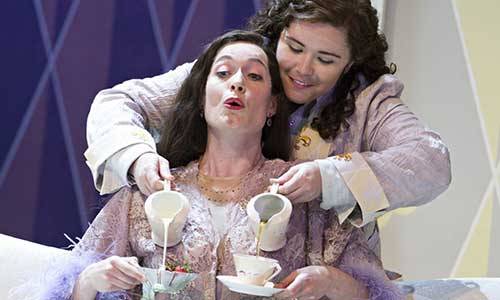
 Kate Royal (left) and Tara Erraught in Glyndebourne’s Der Rosenkavalier
From an article in The Guardian, July 18
The Rosenkavalier represents the apogee of Richard Strauss’s popularity, and perhaps of his life. He had a deep affection for it, a profound identification with it; in his will he stipulated that the work’s sublime final trio, the greatest of his many love letters to the soprano voice, should be played at his funeral, which took place in 1949, in still war-blasted Munich. A 36-year-old Georg Solti conducted; as the soaring, overlapping lines arched out over the orchestra, each of the three singers, Marianne Schech, Maud Cunitz and Gerda Sommerschuh, broke down, overcome by emotion, the words, speaking of valediction and the hope of new life, unbearably poignant in the circumstances. The great comedy of love and loss, swirling with waltzes and borne aloft with an inexhaustible flow of heart-stopping melody, belonged, like the composer, to a vanished world.
Four years earlier, in April 1945, Lieutenant Milton Weiss of the US army had been dispatched to requisition Strauss’s villa in Garmisch-Partenkirchen at the foot of the Bavarian Alps; the frail 81-year-old composer had emerged, blinking. “I am Richard Strauss,” the former president of the Reichsmusikkammer said, in a weak but firm voice. “I am the composer of Der Rosenkavalier,” as if that explained everything and justified everything, as if nothing more needed to be said. Is it possible that at that inconceivable moment of humiliation, he thought back to the work’s premiere 34 years earlier in Dresden – now just a pile of rubble, but then the gleaming centre of his artistic world
• • • • •
Whether or not Hofmannsthal and Strauss consciously intended Marie Theresa, the field marshall’s wife and a pivotal figure in Rosenkavalier, to represent a world for which time was running out, it is true that forever after it was Strauss’s deepest desire to Stop all the Clocks. Having hit his truest form with Rosenkavalier, he was forever harking back to it, and resisting Hofmannsthal’s attempts to take them into deeper, more symbolic areas; but the composer was never again to create an opera as successful or as satisfying. “Our road starts from Rosenkavalier,” Strauss insisted, but it was not a road that led anywhere.
• • • • •
At the end of his life:
“I am in despair,” he wrote, and out of that came what is perhaps his greatest, certainly his most emotionally charged work, the Metamorphosen for 23 solo strings: a work of shocking, naked power, this is music of the deepest feeling by a man not accustomed to feeling deeply. Nostalgia had informed a lot of Strauss’s music, but this is nostalgia transformed into mourning, a visceral threnody for the world out of which Rosenkavalier had arisen. After that came his swan songs: an oboe concerto which is a 20-minute aria for the instrument – joyous, burbling, tender – and the Four Last Songs, as loving a valediction to the sensual world as has been written, culminating in the great Eichendorff setting which ends: “Wie sind wir wandermüde – Ist dies etwa der Tod?” (How tired we are of wandering. Is this perhaps death?)
 Eric Koch’s new book, New Beginnings, was launched on September 20. The book is available from

“in April 1945, Lieutenant Milton Weiss of the US army had been dispatched to requisition Strauss’s villa” — and in the same month, an American oboist, John de Lancie, happened to be in the U.S. Army unit charged with securing the area around the Bavarian town of Garmisch where Strauss was living. In civilian life, de Lancie was principal oboist of the Pittsburgh Orchestra. He visited the composer in his home, and in the course of a long conversation asked him if he had ever considered writing an oboe concerto. Strauss answered simply “No,” and the topic was dropped. However, in the months to follow, the idea grew on him… (source: Wikipedia)
These four pieces — Rosenkavalier, Metamorphosen, the oboe concerto, and the Four Last Songs — constitute a magnificent testament to the end of an era. Elgar’s last few important works — the violin/piano sonata, the string quartet, the piano quintet, and the cello concerto — stand in the same relation to an earlier era. These are Opus 82-85; the first three date from 1918, and the concerto from 1919. He composed little after that, although he lived to 1934.