
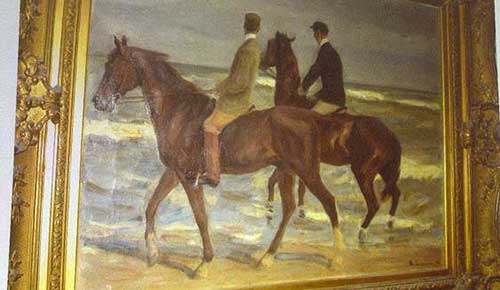
 Experts have to resolve a number of difficult questions when investigating the origin of the fourteen hundred paintings and sculptures that recently emerged in Schwabing, a district of Munich, which before 1914 rivaled Paris as a bohemian centre of creativity. At one time, Schwabing was the temporary home of Lenin and Hitler (not, alas, simultaneously).
The experts have to ask themselves which of these works of art did the Nazis steal from Jewish owners, which did they seize because they disapproved of them as “degenerate”, i.e., modern art, and which were condemned simply because Jews created them? Of course, these categories often overlap.
The picture shown here, Zwei Reiter am Strand by Max Liebermann, a Jew, was painted in 1901. Liebermann was the only first-rate German impressionist. He was also a great character, well known for his courage and wit. The Nazis stole it from a Jewish collector whose family later perished in Auschwitz. (Liebermann died a natural death in 1935. A few years later his widow took poison in Berlin to prevent deportation, after being arrested.)
The Nazis could not conceivably call the picture “degenerate”. That was an adjective reserved primarily for German Expressionists. (Picasso, Matisse and Chagall fell into different undesirable categories.)
In his early years, Goebbels liked the works of German Expressionists. Some of them were Nazi sympathizers. They believed the Nazis would think of them as creators of a special kind of Nordic Expressionism. One of them, Emil Nolde, was even a member of the Party and Max Beckmann thought at first that it was possible to be unpolitical. He soon changed his mind and went into exile in Holland.
Hitler was consistent. He was always a firm believer in neo-classical Kitsch.
Source (in part): Die Zeit, November 6


