
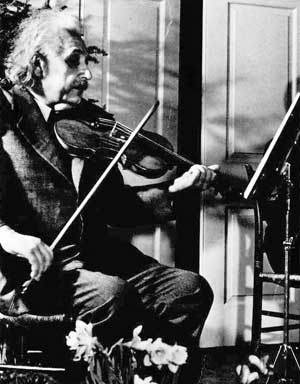
 Violin students, please look at the picture. It is a perfect example of how NOT to hold the violin. And as for the crooked position of the bow on the strings – your teachers would be horrified. The man must have played abominably.
However, don’t be rash. This may be an entirely wrong conclusion. In the 1920s, a Berlin music critic, unaware of Einstein’s fame deriving from physics – perhaps the only Berliner who was unaware of it – wrote: “Einstein’s [violin] playing is excellent, but he does not deserve his world fame; there are many others just as good” (Anton Reiser, Albert Einstein, Boni, NY, 1930, page 202).
In the hugely engaging book by Josef Eisinger, Einstein on the Road, (Prometheus Books, 2011), based on Einstein’s travel diaries, there is this passage from a letter by Helen Bentwich of February 1, 1920, describing an evening of music-making in Jerusalem: “Margery, Thelma, Norman, Feingold and Einstein played a Mozart quintet. Norman on the viola and Einstein on Norman’s violin. He looked very happy while he was playing and played extraordinarily well.”
In January 1930, he played Bach, Mozart and Schumann in Lili Petschikoff’s home in Hollywood. She had been a celebrated violin soloist in her younger days before WWI. In her memoir, she commented on his “fleet fingers” and praised his good tone, and noted that when they played a duet, “not even the most intricate Bach fugue flustered him.” This is in sharp contrast with an old joke musicians have been telling each other for years: when Einstein played sonatas with the famous pianist Artur Schnabel and missed an entrance, Schnabel snapped at him: “Albert – can’t you count?”
And then there was the occasion in Tokyo in December 1922 when, to quote Eisinger, “he was given a gigantic farewell dinner in which Tokyo’s entire intellectual elite took part. Einstein had to give a speech, and when he was politely compelled to play the violin, he performed Beethoven’s Kreutzer Sonata.” In a note at the end of the book, Eisinger wryly comments: “A bold choice indeed. Beethoven’s Opus 47 is a brilliant work that puts considerable musical and technical demands on both violinist and pianist.” The comment may be over-generous. Few non-professionals would dare to play in public one of the most difficult works in the repertoire. The reason why there is no record of the quality of his playing it may very well be the discretion of those who heard it.
But Queen Elizabeth of Belgium was delighted to play with him. She was a highly respected figure in the world of music, after whom the Queen Elizabeth Competition is named. “In October 1930, Einstein paid a visit to the royal couple in their Brussels castle,” Eisinger writes, “where he played chamber music with the queen.” He had met her first the previous year, when they played trios with her and a lady-in-waiting.
Even if his playing was not up to their standards, they must have been moved by his enthusiasm and dedication.
They may very well have said: “Whatever is worth doing is worth doing badly.”


Completely unfair last line. We can admire musicians and first time published writers who have dedicated themselves to a hobby or amateur production for the quality and perserverence without comparing their performances to the best professionals of their age!
Same as we do of high performance athlete with an unrelated day job.
Mike Sky