
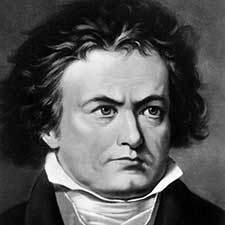
 Beethoven would. He turned his back on it. He had nothing uncharitable to say about he rest of the Ninth Symphony, but the final, choral, movement – Schiller’s Ode to Joy – struck him as a fundamental mistake – a Missgriff. He intended to substitute another movement, for instruments alone, and had an idea for it. His reasons are not clear.
Whatever they were, what would he have said had he heard the views of the French writer Maurice Maucler who, in 1918, after the French victory over Germany in WWI, wondered whether the Ninth Symphony could be taken away from Germany. “A German wrote it. But Germany has lost the right to own it.”
Source: Dieter Hildebrand in Literaturkritik.de, fall issue


I sure would love to know the source for this report. I just heard a really terrific talk, yesterday, at the Juilliard School, by Nicholas Bell — the curator of music manuscripts at the British Library. The British Library owns the hand-written copy of the Ninth Symphony which Beethoven himself sent to the Philharmonic Society of London, in fulfillment of his commission from them. (To be clear: this is not the autograph, which Beethoven himself wrote out and which was used by the copyist to make the performing copy. The autograph is in Berlin). Dr. Bell gave a detailed rundown of the events leading up to the commissioning of the work, how long it took Beethoven to write it, what he was paid (peanuts, but that’s another story having to do with B’s devious dealings with London), and the difficulties of mounting the rehearsals and performance — which had twice as many rehearsals as was usual for the Philharmonic Society orchestra, namely, TWO!
Beethoven was so keen on the work that he lied to his London contacts when he promised them not only the first performance, but all performing rights for the following 18 months. In fact, he organized TWO performances in Vienna before even sending the work on to London.
The reason for the talk is that the Juilliard School has the other hand-written contemporary copy, made a bit before the one now at the British Library. Juilliard’s copy is what Beethoven himself used when he gave the first performances in Vienna. It contains about 1,000 corrections made by Beethoven in pencil, and was the one used to make the first printed publication. It was also used to make the “clean copy” now in London. That’s because Beethoven’s handwriting was so abominable that even he couldn’t use his autograph as a conducting score, and after he had worked over the copyist’s copy, it too was too shabby to send on to London, so a second copy was made.
The two handwritten copies are on display at the school, united for the first time since 1824 when they sat on Beethoven’s writing desk, one to be sent to London, the other to be sent to Schott, his publisher. They’ll be moved to the Morgan Library next week, if anyone is in NYC and wants to see them.
The point of all this history is that it comes from the RLS Archives, now held British Library. All the information comes from primary documents: the RLS minute books, and copious correspondence from Beethoven and the various people involved in bringing the 9th into existence. No hint ever pops up that Beethoven was anything but fiercely possessive and proud of the work, and we know that he considered it on a par with his Misa Solemnis. (At the first Viennese performance, the Misa was on the first half of the program, the Symphony on the second!!). So when I ask the source for the statement that Beethoven considered the 9th a Misgriff, I’d like to know where this comes from. A one-time cranky letter he wrote when he was in a bad mood and had understood how difficult the work was? One has to realize that this was the longest symphony in the history of music up to that time, and was a tremendous undertaking for all involved. The Philharmonic received a work they could barely conceive. The copyists were appalled when they saw what work was ahead for them. One of them pointed out that the trumpet part alone was longer than most violin parts for a complete symphony, As you can imagine, the early performances were not exactly perfection! The double bass part, by the way, was the most difficult ever written at that time, and in London, where it was clear that their orchestral double bass section could not play the opening recitative of the Choral Movement opening, the part was marked in pencil by the London conductor “Solo”, so that the one player who could handle it would be the only person to play it.
The occasion for the arrival of the manuscripts and Dr. Bell’s wonderfully informative talk is a celebration of the (now) Royal Philharmonic Society’s 200th birthday, and a joint concert with the New York Philharmonic tomorrow night at Lincoln Center (to which I have the very greatest pleasure of having been invited!!!).
I hope someone has the answer my question as to the source of Beethoven’s comment. For the moment I’m dubious as to authenticity. The Ninth continued in the Philharmonic Society’s repertory, and when Beethoven was mortally ill, the Society sent him a gift of 100 pounds in appreciation. If I see Dr. Bell, I’ll ask him what he knows about it.
I owe this information to Josef Eisinger. Ask him.
Thank you, Styra, for your very interesting comment. My father is a trusting soul, but quite willing to be corrected, if it comes to that.
First the Euro comes under siege, now the place of “Ode to Joy” in the eyes of its creator? Shame! Sources please!
In defense of the story that Beethoven dissed his Ninth, the source, I now find from Eric, is a story posted by a very quirky but usually ultra-reliable Viennese musicologist named Michael Lorenz. I haven’t yet read his web article (I think anyone can find it on the web), but will, and will report! Now my curiosity is piqued.