
A guest posting by Charles Small, aka curmudgeon, who is not sure he’s ready for Prime Time.
Like most first-year university students of my generation, I survived a “Philosophy 101” course: in two brief semesters we sped from Socrates to Sartre with stopovers at all the big names in between. Among much else, we read several of Montaigne’s essays. I still have those books: the first complete paperback edition (1960), all the essays in three compact volumes, translated by Donald M. Frame. This set has traveled with me more than half a century, through at least ten house-movings and more than a dozen book-weedings.
Not long ago I picked up Volume 1 and began reading. Before long I was hooked. A few days ago I came to the end of Volume 3 and closed the book, reluctantly.
Pinning down Montaigne’s appeal is not easy, but my left-coast cousin comes close: “Montaigne’s language cuts near the bone.” The more you read him, the more it feels like he’s speaking directly, intimately, to you. It’s a remarkable sensation.
I am thoroughly ignorant of 16th century French and cannot attest to the translation’s accuracy, but I can vouch for its excellence as compulsively readable English prose, intricate where necessary but lucid and literate throughout. A few snippets:
From Of idleness: “Lately when I retired to my home, determined so far as possible to bother about nothing except spending the little life I have left in rest and seclusion, it seemed to me I could do my mind no greater favor than to let it entertain itself in full idleness and stay and settle in itself, which I hoped it might do more easily now, having become weightier and riper with time. But I find…that, on the contrary, like a runaway horse, it gives itself a hundred times more trouble than it took for others, and gives birth to so many chimeras and fantastic monsters, one after another, without order or purpose, that in order to contemplate their ineptitude and strangeness at my pleasure, I have begun to put them in writing, hoping in time to make my mind ashamed of itself.”
From Of the affection of fathers for their children: “It was a melancholy humor, and consequently a humor very hostile to my natural disposition, produced by the gloom of the solitude into which I had cast myself some years ago, that first put into my head this daydream of meddling with writing. And then, finding myself entirely destitute and void of any other matter, I presented myself to myself for argument and subject. It is the only book in the world of its kind, a book with a wild and eccentric plan.”
From Of practice: “…it should not be held against me if I publish what I write. What is useful to me may also by accident be useful to another. Moreover, I am not spoiling anything, I am using only what is mine. And if I play the fool, it is at my expense and without harm to anyone. For it is a folly which will die with me, and will have no consequences…. It is a thorny undertaking, and more so than it seems, to follow a movement so wandering as that of our mind, to penetrate the opaque depths of its innermost folds, to pick out and immobilize the innumerable flutterings that agitate it. And it is a new and extraordinary amusement, which withdraws us from the ordinary occupations of the world, yes, even from those most recommended.”
From Of giving the lie: “And if no one reads me, have I wasted my time, entertaining myself for so many idle hours with such useful and agreeable thoughts? In modeling this figure upon myself, I have had to fashion and compose myself so often to bring myself out, that the model itself has to some extent grown firm and taken shape. Painting myself for others, I have painted my inward self with colors clearer than my original ones. I have no more made my book than my book has made me – a book consubstantial with its author, concerned with my own self, an integral part of my life; not concerned with some third-hand extraneous purpose, like all other books. Have I wasted my time by taking stock of myself so continually, so carefully?”
From Of the art of discussion: “I have tried to make myself as agreeable as I saw others unpleasant, as firm as I saw others lax, as mild as I saw others violent. But I was setting myself unattainable standards.”
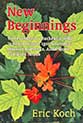 Eric Koch’s new book, New Beginnings, was launched on September 20. The book is available from

Thanks for this excellent posting. Montaigne has been called, among other things, the father of all bloggers, so it’s very appropriate to read him here. Many of you probably know Sarah Bakewell’s great book about him, “How to Live”. If you haven’t, you have a treat in store.
I wrote a book which collected Brahms’s letters (in English!) and when writing the Introduction, found exactly the description of the great composer I needed in an essay of Montaigne’s. Ever since, he’s been one of my literary heroes for years. Thanks, kindly Curmudgeon, for bejeweling the day with these quotes.
Thank you for what is, even at this stage of my life, an introduction to Montaigne. Now I’m hungry for more!