
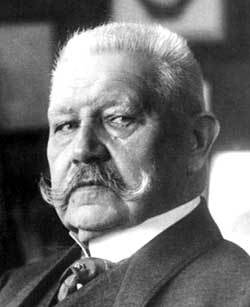
 Germany had two military leaders in WW1: Ludendorff and Hindenburg (pictured here). At the conclusion of the war, Hindenburg announced his intention to retire from public life. In 1919, he was called before a Reichstag Commission that was investigating the responsibility for both the outbreak of war in 1914 and for the defeat in 1918.
Hindenburg had not wanted to appear before the commission. He was subpoenaed. It was an eagerly awaited event. Ludendorff, who had fallen out with him over the decision to continue seeking the armistice in October, was concerned that Hindenburg might reveal that it was he, Ludendorff, who had advised seeking an armistice in September.
When Hindenburg did appear before the commission, he refused to answer any questions about the responsibility for the German defeat, and instead read out a prepared statement that had been reviewed in advance by Ludendorff’s lawyer. Hindenburg testified that the German Army had been on the verge of winning the war in the autumn of 1918, and that the defeat had been precipitated by a Dolchstoß (“stab in the back”) by disloyal elements on the home front and by unpatriotic politicians.
Despite being threatened with a contempt citation for refusing to respond to questions, Hindenburg simply walked out of the hearings after reading his statement. Hindenburg’s status as a war hero provided him with a political shield. He was never prosecuted.
Hindenburg’s testimony was the first use of the Dolchstoßlegende. The term was later adopted by Hitler who also blamed the socialist founders of the Weimar Republic for the loss of the war.
Hindenburg was elected President of the Weimar Republic in 1925.
 Eric Koch’s new book, New Beginnings, was launched on September 20. The book is available from

Serendipitously, I learned about this Dolchstoßlegende just a few days ago, in Terry Eisinger’s lovely book, Einstein on the Road. Here’s how he tells the story: “At the battle of Amiens [starting in August 1918], hundreds of Allied tanks broke through the German lines. Ludendorff recognized that the situation was hopeless and informed the kaiser that the war was lost…. Since the public had been led to believe until the very end that victory was within Germany’s grasp, and German armies stood deep within France and Russia, this sudden military collapse shocked the civilian population profoundly. Many gave credence to the so-called Dolchstoßlegende, or “dagger thrust legend,” the myth that the army had not been defeated but had been stabbed in the back by the politicians. This claim was to become a rallying cry of the Nazis.”