
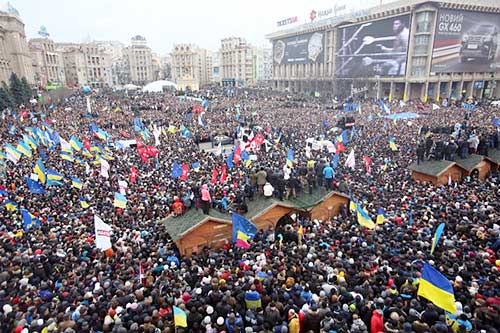
 The New York Times reported yesterday, Sunday, December 1:
Kiev, Ukraine – More than 100,000 people took to the streets of Kiev on Sunday, and thousands more rallied in other cities across Ukraine, to demand the resignation of President Viktor F. Yanukovych, the largest outpouring of fury so far over his refusal to sign far-reaching political and trade accords with the European Union.
Speakers at the rally in Kiev said that protests – now in their 11th day – would continue until Mr. Yanukovych was toppled and new elections were called.
The Economist wrote on November 30:
History, as every schoolboy knows, is often shaped by the courage, zeal and evil of titanic leaders. Less famously, it is sometimes swayed by the venality and self-interest of pygmies. That is frequently the case in the countries of the former Soviet Union, and seemed this week to be the tawdry fate of Ukraine. Viktor Yanukovych, its president, decided against signing a trade deal with the European Union. In the process, he appeared to hand victory to Vladimir Putin in a struggle with the EU over Ukraine’s geopolitical orientation. Yet for all the dismay he caused, this might prove a better outcome than it looks – if the Europeans stick to their guns.
“I want to live in Europe,” proclaimed some of the placards waved in Kiev this week. By many historical measures, Ukrainians already do: parts of their country once belonged to Poland and Austria-Hungary. Mr. Yanukovych nevertheless turned his back on the agreement he was due to sign at a summit in Vilnius. Facing an election in 2015, and desperate for cash to prop up an economy he has helped to ruin, he looked instead to Russia, which he hopes will offer cheap gas and loans with few conditions and little awkward oversight. He may (or may not) join a rival customs union that Mr. Putin is pushing. The terms of Russia’s offer are murky – and Mr. Yanukovych is now trying to placate the EU – but however he dresses it up, this was plainly a choice made more in his own interests than in his country’s.
His slipperiness is, ironically, one reason not to be too downbeat. Had he signed the EU deal, Mr. Yanukovych would probably have reneged on its terms, at the same time using the union’s imprimatur as evidence of his respectability. Moreover the EU has – just – emerged from this squabble without seriously compromising its attachment to the rule of law and human rights. Having unwisely been drawn into a tug-of-war with Russia, it was tempted, for example, to ditch its demand for the release of Yulia Tymoshenko, the opponent whom Mr. Yanukovych has imprisoned. Doing so would have suggested to both current and aspirant members of the EU that its talk of rules and democracy was so much cant.
The other reason to be upbeat is the reaction of Ukrainians. Tens of thousands went onto the freezing streets in protest – an uncomfortable reminder, for Mr. Yanukovych, of the orange revolution of 2004, itself provoked by a bid to rig a presidential vote in his favour. Back then, Ukrainians were demonstrating for clean government and fair elections. Most have since concluded that integrating with the EU is their best hope of achieving them. (Note to Mr. Putin: few people freely demonstrate for sleazy authoritarianism.)
It is far better for the EU that the backlash against Mr. Yanukovych comes from the streets of Kiev rather than from Brussels. But the Europeans can still help. To begin with, they should threaten and enact severe penalties if he uses force against protesters (as his side might have done in 2004, had outsiders not intervened). Travel bans and frozen bank accounts have proved effective weapons against post-Soviet kleptocrats. If he attempts yet another east–west auction of his country, the Europeans should be firmer in their principles: offering inducements only increases his leverage with Mr. Putin. They must remember that, in their values and reputation, they have more at stake than Mr. Putin ever could.
The sad reality is that Ukraine’s politics are too dysfunctional to expect much European integration soon. Mr. Yanukovych – whose rap-sheet features cronyism and claims of media harassment, alongside election-rigging and the selective incarceration of his enemies – has lost his chance to swap a gangster’s reputation for a statesman’s. He has probably made his cherished re-election less, rather than more, likely. But he is not the whole problem. Ukraine’s current generation of leaders rose to power in its first, cut-throat decade of independence, and seem to regard government jobs and policies as assets to be milked. And the milkers include Ms. Tymoshenko’s orange revolutionaries, whose hypocrisy, greed and back-stabbing brought Mr. Yanukovych to power.
The demonstrators in Kiev trust none of them and have no real leaders. Until new ones emerge, the West should concentrate on the Ukrainian people. That means kinder visa arrangements, more exchange visits for Ukrainian students, support for pro-democracy groups and election-monitoring. The EU must show the protesters that their feelings are reciprocated, even if their rulers are too myopic to share them.


