
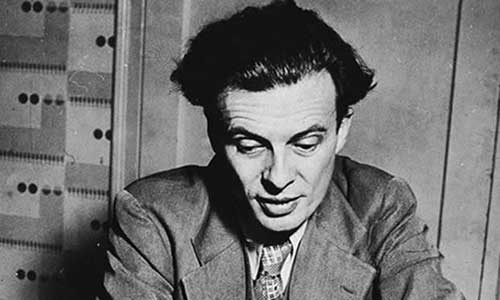
 Last week we were so pre-occupied with the anniversary of the death of JFK that we overlooked that in the same week Aldous Huxley had died. He is pictured above.
One of the ironies of history is that visions of our networked future can be bracketed by the imaginative nightmares of Huxley and his fellow Etonian, George Orwell. Orwell feared that we would be destroyed by the things we fear – the state surveillance apparatus so vividly evoked in Nineteen Eighty-Four. Huxley’s nightmare, set out in Brave New World, his great dystopian novel, was that we would be undone by the things that delight us.
Brave New World was published in 1932. The title comes from Miranda’s speech in Shakespeare’s The Tempest:
“Oh, wonder!
How many goodly creatures are there here!
How beauteous mankind is! Oh brave new world,
That has such people in’t.”
In the novel, Huxley describes the mass production of children by what we would now call in vitro fertilisation; interference in the development process of infants to produce a number of “castes” with carefully modulated levels of capacities to enable them to fit without complaining into the various societal and industrial roles assigned to them; and Pavlovian conditioning of children from birth.
In this world, nobody falls ill, everyone has the same lifespan, there is no warfare, and institutions and marriage and sexual fidelity are dispensed with. Huxley’s dystopia is a totalitarian society, ruled by a supposedly benevolent dictatorship whose subjects have been programmed to enjoy their subjugation through conditioning and the use of a narcotic drug – soma – that is less damaging and more pleasurable than any narcotic known to us. The rulers of Brave New World have solved the problem of making people love their servitude.
On the Orwellian front, we are doing rather well – as the revelations of Edward Snowden have recently underlined. We have constructed an architecture of state surveillance that would make Orwell gasp. And indeed for a long time, for those of us who worry about such things, it was the Internet’s capability to facilitate such comprehensive surveillance that attracted most attention.
As for Huxley’s intuition, we failed to notice that our runaway infatuation with the sleek toys produced by the likes of Apple and Samsung – allied to our apparently insatiable appetite for Facebook, Google and other companies that provide us with “free” services in exchange for the intimate details of our daily lives – might well turn out to be as powerful a narcotic as soma was for the inhabitants of Brave New World. So let us spare a thought for the writer who perceived the future in which we would come to love our digital servitude.
Source: The Guardian, November 22


Sorry, I left a reply to this post, but at the wrong place: at the previous post, on Canada’s International Shame. My bad!
By the law of ‘unintended consequences’, Huxley’s imaginatively conceived social scenario offers a potent recipe on how to attain, psycho-somatically,
a virtual bliss on earth ‘until (mercifully) death do us apart’. Bravo!