
Tag Archives: Wannsee conference

The Mastermind of the Holocaust May Have Been Buried in a Jewish Cemetery in Berlin

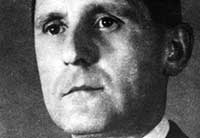
HeinrichMüllerEichmann’s boss, Gestapo Chief Heinrich Müller, had been in the bunker with Hitler in April 1945. Nothing definite was known about his death.

He had participated in the Wannsee Conference on January 20, 1942, when the murder of Europe’s Jews was decided.

Holocaust historians say that Western investigators looked for Müller intensively for years after 1945, and there were reports placing him everywhere from Czechoslovakia to the Soviet Union or even Brazil.

Now, the question of Müller’s fate has taken a disturbing twist, as Professor Johannes Tuchel, head of an association that watches over memorials to German resistance fighters, claims to have uncovered a document indicating that Müller was killed, probably on May 1, 1945, hastily buried in a provisional grave near the Nazi Air Force ministry, and later reburied in a mass grave in the Jewish cemetery in Mitte, in the heart of Berlin.

While the claim is not definitive – lacking, for instance, any forensic verification – it was credible enough to stir a mixture of sorrow, outrage and shock in this city where so much blood and treasure have been spent, and beyond.

Efraim Zuroff, chief Nazi hunter of the Simon Wiesenthal Center, was incredulous when reached by telephone. “I can’t think of a worse desecration of a Jewish cemetery than to bury Heinrich Müller there,” he said.

Professor Tuchel said in a telephone interview that he stumbled on the discovery after investigating Müller’s role in the suppression of a rebellion in the Moabit district of central Berlin on April 22–23, 1945. As the Nazi Reich was crumbling under sustained Allied bombing, and Soviet tank and infantry advances, the Gestapo leader, Professor Tuchel said, ordered 18 resistance fighters in Moabit shot.

His interest piqued, Professor Tuchel said, he scoured archives and found out that Müller was killed in the dying days of the war in May 1945, and buried and reburied, he said.

An estimated 70,000 civilians and soldiers are said to have been killed in the last three weeks of the war in Berlin. In the months after fighting ended, each city district organized non-professional teams of gravediggers to collect corpses and bury them in mass graves, Professor Tuchel said, adding that there were 16 such graves containing an estimated 2,700 bodies in the Mitte Jewish cemetery, which was not used for burials after 1829.

It is the resting place of the 18th-century philosopher – and grandfather of the composer – Moses Mendelssohn.

Source: The New York Times, October 31

Hitlerology, Part Three

1. Hitler outlined the main contours of his purposes in Mein Kampf, published in 1925. But he left their execution to improvisation, depending on what today would be called “conditions on the ground.” The German historian Fritz Fischer compared Hitler’s war aims with the Kaiser’s and found them strikingly similar. He concluded that there had been a continuity of German foreign policy from 1914 to 1945.

Hitler’s primary aim was to eliminate the German defeat in 1918 from the annals of history.

2. There is no question that he had expected that the British would accept his offer of peace after the fall of France in June 1940. His ambassador, Ribbentropp, had conditioned him to believe that it would be favourably received.

The conquest of France was an achievement that had eluded the Kaiser. A captive in Holland, he proudly wrote to is daughter at the time that the military leaders who had achieved this victory had had their training in his army.

3. One may justifiably ask oneself 70 years later whether the world today would be better off if Lord Halifax had been prime minister in June 1940. He would have accepted the offer, and so no doubt would have Chamberlain and the other appeasers. If his reasons had been (A) to save millions of lives; (B) to avoid a war because Britain was not ready to fight; (C) his expectation that within a decade or so the peoples under Nazi and Fascist oppression, including Germany, would shake off the Nazi yoke anyway – an objective that his government would promote as much as possible – such an acceptance would not have been dishonorable. He would have to require assurances that there would be no occupation of the U.K., that no person would be molested by reason of his race, religion or political views as a result of this agreement, and that British institutions, especially the BBC, would remain untouched by Nazi influences. If such assurances were broken, as so many previous assurances by Hitler had been, he would have to convey to Hitler that the British Empire had sufficient resources to renew the war. The implication would have been that once again the Americans would join in, as they had in 1917.

4. As to Hitler’s intentions regarding the Jews, Mein Kampf makes it clear that he intended Germany to be judenrein – free of Jews – but the language he used on the methods to achieve this objective was ambiguous. He described Jews as “parasites, which suggested that they should be dealt with the way we deal with parasites. (The Kaiser also occasionally used this word in relation to Jews but not in the presence of the rich Jews he liked.) Moreover, on January 30, 1939, the sixth anniversary of his assumption of power, Hitler made a speech in the Sportpalast in Berlin in which he said, “I will once more be a prophet. If the international finance-Jewry inside and outside Europe should succeed in plunging the nations of the world into a world war yet again, then the result will not be the bolzhevization of the earth, and thus the victory of Jewry, but the annihilation of the Jewish race in Europe.” Few people took this literally, and it may be questioned whether he himself did since exaggeration and hyperbole were important elements in his rhetoric. Early 1939 was also the time when secret negotiations took place between Hjalmar Schacht, the president of the Reichsbank, in which Gøering also played a part, and George Rublee, the director of the Intergovernmental Committee for Refugees set up by the Evian Conference in 1938, about ways to finance Jewish emigration.

It is now believed that until the outbreak of the war his objective was to encourage emigration. When Jews were released from concentration camps, in the cases when their relatives managed to receive visas for emigration to foreign countries, their passports, which had been seized, were returned.

The main reason for the Wannsee Conference in January 1942 was to devise the logistics for industrial mass murder. The killings by army security forces of many thousands of Jews after the invasion of Russia in June 1941 would from then on be carried out more efficiently and more systematically. Moreover, it had become immensely difficult to establish ghettoes like those in Warsaw and Lodz as gathering points. Once the killing machinery was running, the net for gathering Jews would be spread throughout Germany and occupied Europe.

There is a story that in December 1941, when the Nazis had failed to take Moscow, one or two generals went to see Hitler and told him the war could no longer be won. One reason why Hitler would not listen to them, it was conjectured, was that after failing in Russia his primary objective was to kill the Jews. This could only be done under conditions of warfare.

This story cannot be proven.