1. Al Jazeera: Michael C. Hudson. Professor at Georgetown University
There is no indication that Islamist organizations played a major role. Yet to believe the conservative US media one would understand that what we are seeing is an Islamist terrorist conspiracy. And virtually every Arab regime has fanned this alleged threat in order to win US military, financial and political support. But this is an oversimplification of the complex realities of Arab society and political culture. In Egypt, the Muslim Brotherhood has been so slow to get on board the upheaval that it risks its own credibility. As for Al Qaeda, it is nowhere to be seen.
2. Al Jazeera: Paul Amar is Associate Professor of Global & International Studies at the University of California, Santa Barbara
Mubarak is already out of power. The new cabinet is composed of chiefs of intelligence, air force and the prison authority, as well as one International Labor Organization official. This group embodies a hard-core “stability coalition” that will work to bring together the interests of new military, national capital and labor, all the while reassuring the United States.
Yes, this is a reshuffling of the cabinet, but one that reflects a very significant change in political direction. But none of it will count as a democratic transition until the vast new coalition of local social movements and internationalist Egyptians break into this circle and insist on setting the terms and agenda for transition.
I would bet that even the hard-line leaders of the new cabinet will be unable to resist plugging into the willpower of these popular uprisings, one hundred million Egyptians strong.
3. Ha’aretz : Bradley Burston, American-born Israeli journalist
As an Israeli, I want the Egyptians to win. It is beginning to dawn on my people, the Israelis, that freedom for Arabs may have nothing to do with annihilation for Jews.
Here and there, people here are recognizing that the Arab world, and this grand nation that is its cultural epicenter, is vastly more complex than this view of a vast sea of blood-eyed fanatics barely restrained by the brittle dykes of a heavily subsidized corps of despots.
4. Ha’aretz: Ari Shavit, columnist
The Arab Revolution and Western Decline. How can it be that in May 2009, Hosni Mubarak was an esteemed president whom Barack Obama respected, and in January 2011, Mubarak is a dictator whom even Obama is casting aside? How can it be that in June 2009, Obama didn’t support the masses who came out against the zealot Mahmoud Ahmadinejad, while now he stands by the masses who are coming out against the moderate Mubarak?
There is one answer: the West’s position is not a moral one that reflects a real commitment to human rights. The West’s position reflects the adoption of Jimmy Carter’s worldview: kowtowing to benighted, strong tyrants while abandoning moderate, weak ones.
Carter’s betrayal of the Shah brought us the ayatollahs, and will soon bring us ayatollahs with nuclear arms. The consequences of the West’s betrayal of Mubarak will be no less severe. It’s not only a betrayal of a leader who was loyal to the West, served stability and encouraged moderation. It’s a betrayal of every ally of the West in the Middle East and the developing world. The message is sharp and clear: the West’s word is no word at all; an alliance with the West is not an alliance. The West has lost it. The West has stopped being a leading and stabilizing force around the world.

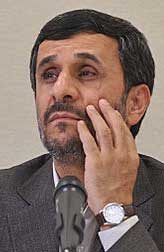 On Tuesday, the Iranian president appeared in parliament to answer questions from MPs. Mr. Ahmadinejad took an hour to respond to a long list of questions about his foreign and domestic policy decisions.
 Eric Koch’s new book, The Weimar Triangle, is available at Indigo-Chapters and in your local bookstore.


