Eric Koch is spending two weeks in Europe. A number of his regular readers have generously volunteered to compose guest-postings – this is the third of three by Tim Lash.
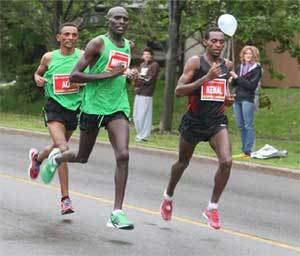 GET SET. Ottawa Marathon runners on Sunday morning, May 29, 2011. The three leaders, two Ethiopians, one Kenyan, float past the 40 km mark at 9:03 am after 2 hours at 325 metres per minute. Grace and cardiovascular talent.
GO. Canadians are reading the political wind released by the May election. Some eyes are trained on the collision course between our essential right to privacy and the unprecedented new police internet surveillance powers in the Omnibus Crime Bill. 100 days, now counting down.
People are slowly starting to name what’s happening in Canadian civic life, and see it in relation to occurrences elsewhere. It has to do with democratic vs. autocratic societies. It’s not just about this or that budget and decisions that allocate common resources and public expenditures. It’s about shaping where control of these decisions lies. It’s about choosing to make fearful exclusion and brute containment prior to trustful inclusion and presumed freedom. En route, at the upcoming fork – we’re almost there and we’re leaning – we’ll choose: carry Canada’s Charter-based legal standards for individual rights and freedoms forward with us, and implement them so they work well and help shape the evolving networked world for us? Or lower the hard-won legal standards? For?
There are potentials and perils in digital data association and storage. Inexpensive “bots” – self-directing data-crawlers – can reach far to associate us automatically, individually, with where we live, who we know and talk to, what we’re apparently interested in, what we buy, where we go, where we are, our patterns of communication; then algorithms can be made to combine all these to profile us individually, however inaccurately, into categories of political risk or commercial opportunity, designed by someone else, for their special attention, enforced restrictions, or privileges, without us knowing it or being able to challenge it. Even when we’re personally targeted and learn of it at a monitored gateway or portal. Access to this associated personal information, control of it, is power – for the state, the company, or the individual. Think George Orwell. Even more, think Franz Kafka, The Trial.
CONTRAST AND COMPARE. In the long-form census program, publicly accountable people aggregate anonymized information from individuals who know themselves, to discover statistically reliable social patterns as worthy objects of public policies in a fair and healthy society of free individuals.
In the Omnibus Crime Bill, the Harper government intends to create new police powers for invasive surveillance of everything we all do on the internet, with no tempering requirement for an individually authorized court warrant. It will enlist private telecoms as state agents in gathering our personal information; they’ll pass the open-ended costs of the technology and activity for this on to Canadians. It’s called “lawful access”. Chilling. It’s against unanimous urgent advice of Canada’s federal and provincial/territorial Privacy Commissioners. Secret surveillance destroys privacy, and privacy in its many nuturing forms is the basis of freedom.
The government hasn’t even tried to demonstrate these new powers are needed or effective for the advertised purpose: public security and safety from individual bad guys. Conscious legislative delays and prorogations have avoided Parliament’s discussion of these proposals – made in different forms by Liberals and Conservatives alike – over more than 7 years. Public consultations have been short, selective, and fitful.
Here’s Robert Knapp, early June, on the same question in the US:
Simply put, the right to someone’s secrets is the right to dominate. As a constitutional democracy, the people should be dominant over the government, not the other way around. I’m not sure why it takes so many words to attempt to express this simple idea.
Last week, by e-mail from a senior Canadian criminal lawyer – this is before warrantless spying:
Much about the crime bill horrifies me. I am on a wiretap case now and it’s spooky to see first the tunnel vision and perhaps deception that is employed in getting the authorization in the first place (ban on publication – can’t say more). Then what they can do to watch the citizenry once authorized: cameras, GPS tracking devices, phone, fax, cellular and text messaging taps. People say if you’re not doing anything wrong you have nothing to fear, but even when they are not misconstruing what’s going on, who wants to be observed/recorded while adjusting your underwear or talking about your relationships or medical exam or whatever.
More alarming is how quickly the authorizations expand to include more and more phones, vehicles, locations, people. Seems half the city is already being surveilled. And really, sometimes “that thing, the big one” is not actually a bag of bomb parts or a boatload of drugs.
In Canada, mainstream media aren’t covering this (yet), but bloggers like Jesse Brown of TVO’s Search Engine are. Similar push by governments has been happening more openly in India, Australia, Europe, USA, and elsewhere. In Europe and USA, so far at least, there’s more active civic push-back, push-forward, and reclaiming of lost democratic ground.
At the end of May, Alex Himelfarb – widely respected and a former Clerk of the Privy Council – posted a blog on where we are with Mr. Harper. Himelfarb gives room to differing views, and he learns. The thread of comments on his blog has the thoughtfulness many of us hope for and miss in public discussion. To respondents tangled in feeling that effort is futile after the election, his answers are a healing sword. You can do what you can. Go ahead. Lâche pas!
Canadians – conservative, progressive, libertarian, socialist, green, electoral reformers, internet mavens – are starting to help it not happen. By early June, more websites were picking it up.
This nearby choice will set the next leg of the course in a Canadian relay that started 170 years ago with Howe, Lafontaine and Baldwin in Halifax, Montreal and Toronto. The prize now is freedom of expression and association, and, as then, responsible government.
If you’re running: “Build on-line privacy. No warrant no spying. Pass it on.” Tell your MP, Mr. Harper, and party leaders certainly. With Parliament as it is today, be sure to use other running lanes too.
Photo: T. Lash
Previous postings: Culture and Empire – Part 1 and Part 2



